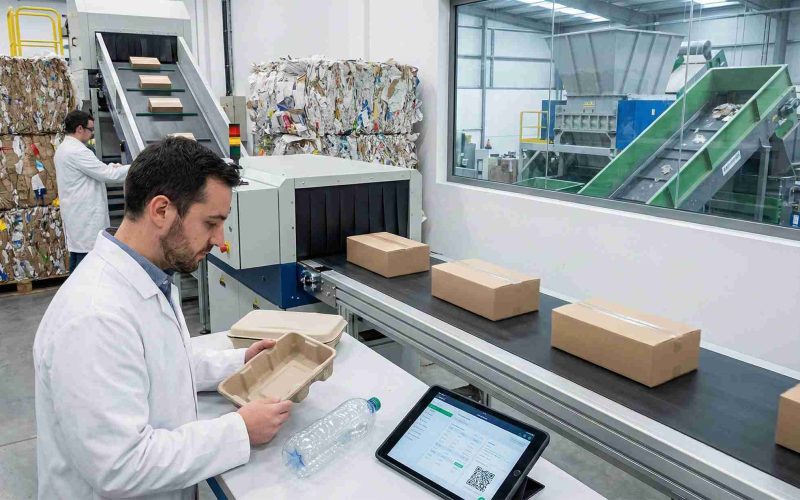
Government wants to standardise waste collection nationwide, including for businesses
For businesses, more concrete measures can only be introduced following a review of the separation policy, which is expected by the end of this year.

On 3 November, Minister Van Veldhoven for Climate and Green Growth sent a letter to the House of Representatives setting out plans to make waste separation at home, at school and at work more consistent. According to the government, without additional measures, the Netherlands is unlikely to meet the European recycling targets for 2030 and 2035.
In 2024, the Netherlands recycled 53.5 per cent of its municipal waste: household waste plus commercial waste that is similar in nature and composition. This is lower than in 2023 (54.6 per cent) and below the 55 per cent target set by the EU for 2025. The targets are becoming stricter: 60 per cent by 2030 and 65 per cent by 2035. If the Netherlands fails to meet them, the European Commission may initiate infringement proceedings, a formal step against the country.
The government cites, amongst other things, the differences between local authorities as a cause. Each local authority is permitted, subject to certain conditions, to opt out of the separate collection of organic waste (vegetable, fruit and garden waste) and PMD waste (plastic packaging, metal packaging and drink cartons). This waste is then disposed of with the residual waste. Around 30 per cent of local authorities do this in some neighbourhoods with organic waste, which is then incinerated rather than recycled. Around a quarter do this with PMD, which is then sorted from the residual waste by machine at a later stage. This is known as post-sorting; source separation refers to the separate collection from residents themselves. Some residents find the differences confusing, and according to the government, this can hinder effective sorting.
The government therefore wishes to scrap the exemption for organic waste. That proposal will be put out for online consultation this coming spring, a public consultation round in which anyone can have their say. For PMD, the guiding principle remains source separation where possible and post-separation where necessary, as prescribed by European regulations. The government is also investigating whether waste separation can be made compulsory in schools.
What this means for businesses
No decision has yet been made regarding businesses. Business owners organise the separate collection of their waste themselves, through a contract with an authorised waste collector; local authorities play no role in this. An independent review of this policy for businesses and institutions is expected by the end of this year. Following this, the government intends to work with the business community and the relevant authorities to develop a waste separation policy that applies uniformly to businesses across the board. This could also reduce the regulatory burden.
In addition, the government is considering an extra mechanical sorting stage for residual waste from households and businesses. Sorting or processing companies would sort the waste again after collection for this purpose. On average, 80 per cent of residual waste is still recyclable. The letter does not elaborate on how this would work for businesses.
The letter announces no changes regarding packaging. Extensive producer responsibility already applies in this area: anyone who places packaging on the market is responsible for organising and paying for the collection and processing of the resulting waste. Where this scheme applies to commercial waste, the letter states that businesses do not need to pay for the collection itself: producers are responsible for this. The plans will be further developed in the coming months in consultation with sectors and other public authorities, and the Government will keep the House of Representatives informed.
Sources
Lees verder
Gerelateerde berichten
EU Council wants to exempt small packagers from the requirement to appoint an authorised representative
The Council adopted its negotiating position on 21 October. It is a mandate for negotiations with the European Parliament and is not yet a law.
2027 price ranges for materials and deposit rates announced
Verpact has published the ranges for material charges and producer contributions within the deposit-refund scheme for 2027. For packaging producers and brand owners, these figures are key to their cost calculations and budget planning. These frameworks stem from the broader European PPWR regulations.