
The SnackBox: Sustainable innovation or a clever marketing ploy?
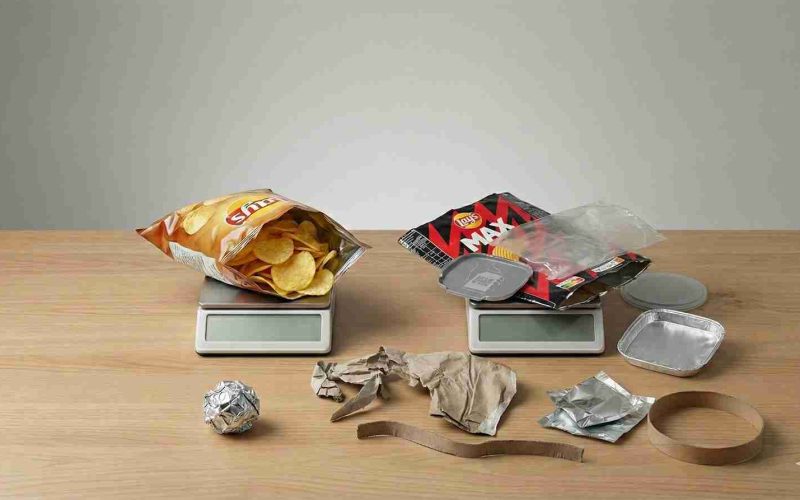
Is the new cardboard SnackBox really better for the environment? An analysis of its weight, materials and price increase (shrinkflation) reveals some striking figures.
The traditional crisp packet now has a rival: the cardboard SnackBox. The adverts focus entirely on ease of use and ‘less plastic’, but experts and consumer organisations have serious doubts about this innovation. Is this really a sustainable step forward, or are we (and the environment) paying an invisible price?
We delved into the figures on materials, logistics and price.
Ease of use: The undisputed advantage
Let’s be honest: the SnackBox solves a number of classic annoyances. Where a flimsy bag tears and falls over, the new tube offers advantages:
- Stability: The box stays upright, which is ideal for sharing at the table.
- Protection: The sturdy sides prevent you from ending up with a bag full of crumbs.
- Freshness: Thanks to the resealable lid, you’re less likely to throw food away.
So much for the good news.
The ‘cardboard look’ unmasked: More waste than you think
Although the outside screams ‘cardboard’ and manufacturer PepsiCo claims it can largely be recycled as waste paper, the reality is more nuanced. Waste expert Dirk Groot (the Zwerfinator) analysed the packaging and came up with some shocking figures:
- Traditional bag: Weighs a total of 8 grams (entirely plastic/foil).
- The SnackBox: Weighs a total of 64 grams.
The painful conclusion? Of those 64 grams, 11 grams consist of plastic and aluminium and 53 grams of cardboard. That means the ‘sustainable’ cardboard box weighs more in plastic and aluminium alone (11 grams) than an entire old-fashioned plastic bag (8 grams).
What’s more, separating these composite materials in recycling plants is complex, meaning that the actual circularity is often disappointing.
The Logistics Paradox: Moving air
Sustainability goes beyond the packaging itself; it’s also about transport.
- The old situation: A traditional bag starts out as a flat roll of film. One roll makes thousands of bags – extremely efficient.
- The new situation: Tubes take up an enormous amount of space. Whether they arrive ready-made or are assembled on site, a great deal more ‘air’ is transported before the crisps are even inside.
This results in more lorries on the road and a larger carbon footprint throughout the supply chain.
Shrinkflation: Fewer crisps, higher price
It’s not just the environment that’s paying the price; your wallet is feeling the pinch too. The TV programme *Kassa* (BNNVARA) revealed that the introduction of the SnackBox has been accompanied by significant ‘shrinkflation’.
The contents often decrease considerably (for example, from 185 to 125 grams), whilst the price remains the same or rises. In extreme cases, consumers pay 48% to 76% more per kilo of crisps. So you’re effectively paying for the marketing campaign and the more expensive packaging.
Conclusion: A matter of perspective
The SnackBox is a fine example of product design that certainly meets a need for ease of use. But a critical eye will see that the ‘sustainability claim’ is flawed:
- Material: A massive increase in weight (from 8g to 64g).
- Logistics: Inefficient transport of air.
- Price: A disguised price increase for the consumer.
True sustainability requires a holistic approach in which weight, logistics and a fair price go hand in hand.
This article is an independent analysis by Nederland Verpakt, based on public sources and data.
Lees verder
Gerelateerde berichten
Innovative biomaterials: from experimentation to upscaling
Biomaterials in packaging are making the transition from a niche market to large-scale production. Discover the trends, opportunities and challenges for manufacturers and brands.
Packaging recycling in the Netherlands: sorting plant
In 2024, the Netherlands achieved a record recycling rate of 88% for packaging. Find out what this means for producers, the PPWR legislation and your EPR contribution.